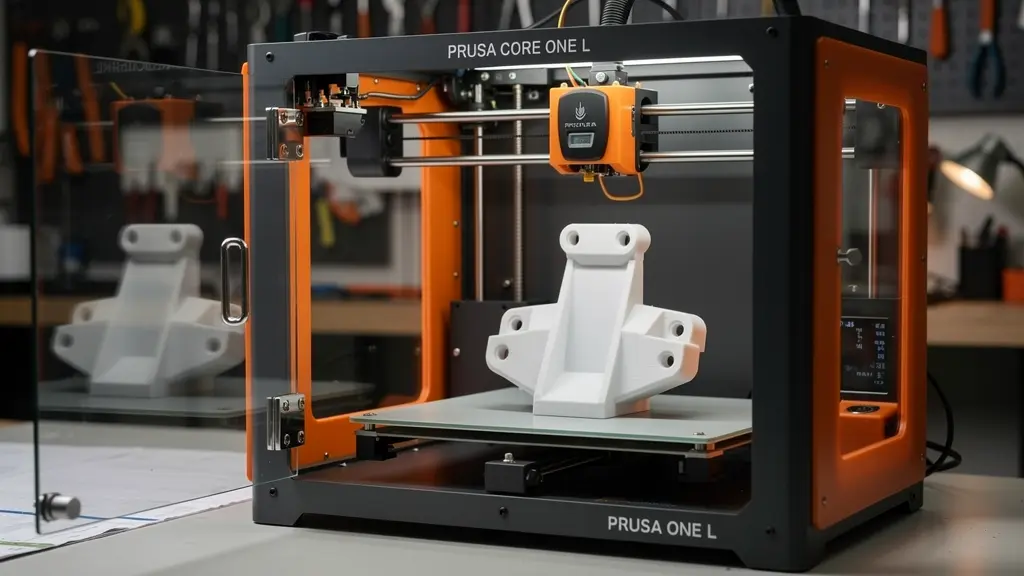
Not every 3D printer can do what 3D3D needs it to do. The machine has to print engineering-grade materials. It has to travel as checked luggage on commercial flights. It has to run on whatever power is available. And it has to produce parts reliable enough to go on working vessels.
The Prusa Core One L checks every box. Here is why.
The Specs
Build volume: 300 x 300 x 330mm. That is large enough for almost any marine fitting, bracket, housing, or component that a vessel needs. Cleat bases, winch handle holders, instrument housings, ventilation cowls, structural brackets. If it fits in a 300mm cube, it prints in one piece. Larger parts get split and assembled.
Maximum nozzle temperature: 290°C. This is the number that matters. At 290°C, the Core One L prints ASA, PETG-CF, PA-CF (carbon fiber nylon), polycarbonate, and every standard material below them. That covers the full range of marine applications from UV-stable deck hardware to high-load structural components.
Enclosed heated chamber. This is non-negotiable for engineering materials. ABS, ASA, nylon, and polycarbonate warp without chamber heat. An open-frame printer cannot reliably print these materials. The enclosure also protects the print from drafts, which on a vessel means wind through open hatches and companionways.
Why It Travels
The Core One L fits airline checked luggage dimensions. It packs into a hard case and goes on a commercial flight. This has already been proven. Ken has transported printers internationally multiple times. Canada to Toronto to London to Southampton. The printer travels like any other piece of professional equipment.
This is why 3D3D does not operate from a fixed workshop. The printer goes where the vessel is. Bermuda, Cherbourg, Antigua, Southampton. Wherever the vessel needs a part, the printer shows up. No shipping delay. No customs delay on finished parts. The raw material travels in the same luggage.
For comparison, most industrial 3D printers weigh hundreds of pounds and require dedicated power systems. They do not leave the workshop. The Core One L is a professional machine in a portable format.
Power
The Core One L runs on standard AC power. Shore power at a marina. A generator at a remote anchorage. The vessel's own inverter system. The power draw is manageable. It does not need a dedicated 30-amp circuit. It does not need three- phase power. It plugs in and runs.
On Osprey, the vessel's power system includes Starlink, navigation electronics, and all the standard marine loads. The printer adds to that load but does not overwhelm it. A print job can run overnight on shore power while the crew sleeps. By morning, the part is done.
For generator-powered scenarios, the printer runs on a standard portable generator. The kind that costs a few hundred dollars and fits in a cockpit locker. No specialized power conditioning required.
Material Compatibility
At 290°C, the Core One L handles the materials that matter for marine work.
ASA for anything that lives outside. UV-stable, weather-resistant, does not degrade in salt spray. Deck fittings, cockpit hardware, fairleads, ventilation covers.
PA-CF for structural applications. Carbon fiber reinforced nylon. High stiffness, high strength, low weight. Winch components, block mounts, load-bearing brackets.
PETG-CF for chemical resistance. Engine bay components, fuel system fittings, bilge pump housings. Handles fuels and cleaning agents without degradation.
Polycarbonate for impact resistance. Protective covers, instrument guards, sight glasses. The same material class used in aircraft canopies and motorcycle visors.
TPU for flexible applications. Gaskets, seals, bumpers, chafe guards, anti- vibration mounts. Parts that conventional machining cannot produce at all.
What Sets It Apart
Prusa builds machines that work. Not machines that look good in a marketing photo and fail on the third print. The Core One L uses a CoreXY motion system for speed and accuracy. The heated chamber maintains consistent temperature throughout long prints. The build plate adhesion is reliable enough that prints do not fail overnight when nobody is watching.
Reliability matters more on a vessel than anywhere else. A failed print at home wastes material and time. A failed print at sea wastes the only opportunity to get a part made before the next port. The Core One L completes prints. That is the baseline requirement and it is the reason this machine was chosen over every alternative.
The Prusa partnership confirmed this. When Prusa Research saw what 3D3D was building, they provided the Core One L and confirmed the partnership. The machine arrived April 8, 2026. It is going aboard Osprey for Newport-Bermuda 2026 on June 19. After that, the Global Solo Challenge. A 3D printer circumnavigating the globe solo.
The Bottom Line
A 3D printer that goes to sea needs three things: the capability to print engineering materials, the portability to travel internationally, and the reliability to produce parts without supervision. The Prusa Core One L delivers all three. That is why it is the machine that goes to sea.
Need custom marine parts printed and delivered?
3D3D prints engineering-grade parts for vessels worldwide. Reply within 24 hours.
Request a Part