Most vessel owners have never seen a full refit documented start to finish. They get a quote, they get an invoice, and somewhere in between their boat sat in a yard while things happened. This is what actually happens when you strip a vessel down to bare systems and rebuild everything.
The vessel was Americas Challenge, a Whitbred 60 class racing yacht. Sister ship to Yamaha, the 1993 round-the-world winner. She was later renamed Challenger. The refit took six months. The hours varied. Some days were 10am to 4pm. Some days were 24 hours straight.
Phase 1: Scope Definition
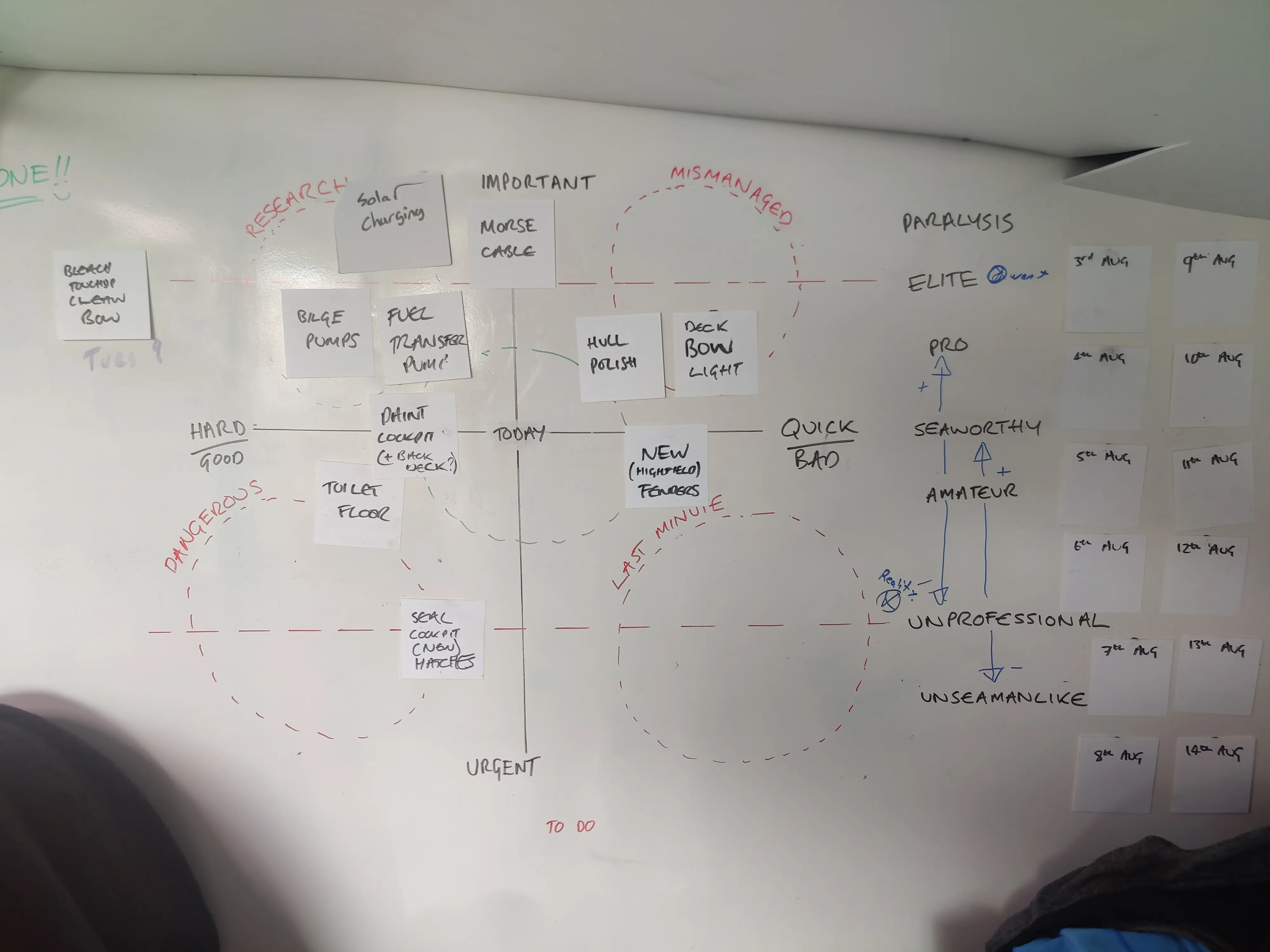
Before anything gets touched, you need a complete scope document. Every system on the vessel gets inspected, photographed, and catalogued. What works, what does not, what is marginal, and what will fail in the next 12 months. This is not a quick walkthrough. It is a systematic audit of every hatch, fitting, wire, hose, and fastener on the boat.
The scope document becomes the contract. It defines what gets done, what gets deferred, and what the budget covers. Without this, refits blow budgets every time. A refit doubles in cost because nobody wrote down what was actually wrong before they started pulling things apart.
On Challenger, the scope covered hull, deck, electronics, plumbing, engine, interior, safety equipment, rigging, and sails. Every system. No exceptions.
Phase 2: Hull and Deck
The anti-foul comes off first. On Challenger this meant stripping every layer down to the Kevlar hull. Old anti-foul that has been layered over years traps moisture and hides damage. You cannot assess hull condition through old paint.
Once stripped, the hull gets inspected for osmotic blistering, impact damage, delamination, and stress cracking. Kevlar hulls are tough but they show damage differently than fiberglass. You need to know what you are looking at.
Deck paint gets stripped and reapplied. Every hatch cover gets removed, inspected, resealed, or replaced. On Challenger, every hatch cover was sealed because the original seals had degraded to the point where they were taking water in rough conditions.
Phase 3: Electronics
Every electrical connection on the vessel gets pulled apart. Every terminal, every splice, every junction. Corrosion gets cleaned. Connections get rebuilt with proper crimps and heat shrink. Dielectric grease goes on every connection that is exposed to moisture, which on a boat is all of them.
This is the work that yards skip because it is invisible. Nobody sees the inside of a wire run. But corroded connections cause instrument failures, charging problems, and electrical fires. On a vessel crossing the Atlantic, a charging system failure means no navigation instruments, no autopilot, and no communications.
On Challenger, every single electrical connection was gone through. Not tested. Not spot checked. Every one.
Phase 4: Plumbing
Every through-hull fitting gets inspected. Every hose gets checked for softening, cracking, and swelling. Every hose clamp gets checked for corrosion. Below-waterline fittings that show any degradation get replaced because the alternative is flooding.
On Challenger, every plumbing connection was tightened and checked for rot in the surrounding structure. Rot around a through-hull is a sinking waiting to happen. The wood or composite around the fitting can look fine from the surface while the core has gone soft.
The toilet floor was custom-built from scratch. This is the kind of work that does not appear on a yard invoice as a line item but takes days to do properly.
Phase 5: Engine and Mechanical
Engine work on Challenger included rebuilding part of the intake system. The propeller was serviced. The cutlass bearing was inspected and the greaseless bearing checked. The engine mounts, shaft alignment, and exhaust system were all gone through.
During the Atlantic crossing that followed the refit, the generator ran dry and destroyed the impeller. Ken rebuilt the impeller at sea with hand tools during a bomb cyclone. That is not part of the refit scope. But it demonstrates the difference between someone who refits a vessel by checking boxes and someone who understands every system well enough to rebuild it under the worst possible conditions.
Phase 6: Interior
All bunks on Challenger were rebuilt. This required metalwork for the frames and new fabric for the cushions and covers. Cockpit bags were reorganized and rebuilt. Storage systems were rebuilt to handle offshore conditions where everything that is not secured becomes a projectile.
Interior work on a racing yacht is different from a cruising yacht. Weight matters. Every item that goes back on the boat needs to justify its weight. Every storage solution needs to survive a knockdown.
Phase 7: Sails and Rigging
Sail work was coordinated with the sailmakers. The Dacron sails were inspected, repaired, and logos and graphics were applied. This is coordination work. You are managing the relationship between the sailmaker, the graphic designer, and the schedule. If the sails are not ready, the vessel does not leave.
Rigging inspection on a Whitbred 60 is serious. These boats were designed to race around the world. The loads on the standing rigging are enormous. Every swage fitting, every toggle, every pin gets inspected for cracking, wear, and corrosion.
Phase 8: Documentation
Every step gets documented. Photos before, during, and after. Part numbers recorded. Torque values logged. Material specifications filed. This documentation is the vessel's service history. It is what the next surveyor will reference. It is what the insurance company will ask for. And it is what the next person managing the vessel will need to understand what was done and why.
Documentation is the part that separates professional vessel management from “I hired a guy.” When there is no paper trail, there is no accountability and no continuity.
What This Costs
The Challenger refit was six months of full-time work on a Whitbred 60. A yard doing the same scope would cost significantly more depending on location and markups. [pricing removed — contact for current rates]
The difference is overhead. A yard has shop rent, insurance, management staff, scheduling overhead, and profit margin on every subcontractor. An independent operator working directly for the vessel owner eliminates everything except the work itself.
For a comparable yard scope, 3D3D delivers the same work, same quality, same documentation — with less overhead. [pricing removed — contact for current rates]
The Refit That Led to the Hurricane
The Challenger refit was the project that preceded the February 2016 Atlantic crossing. The vessel that Ken rebuilt is the vessel that survived a bomb cyclone with 95-knot gusts. The hatch covers that Ken sealed held. The electrical systems that Ken rebuilt kept the instruments running. The engine work held up through the worst conditions the Atlantic can produce.
A refit is not just maintenance. It is preparation. When the conditions get bad, the quality of the refit determines whether the vessel and crew make it through.
Planning a refit and need someone who has done it?
Vessel management, refit oversight, parts sourcing. Reply within 24 hours.
Make an Enquiry