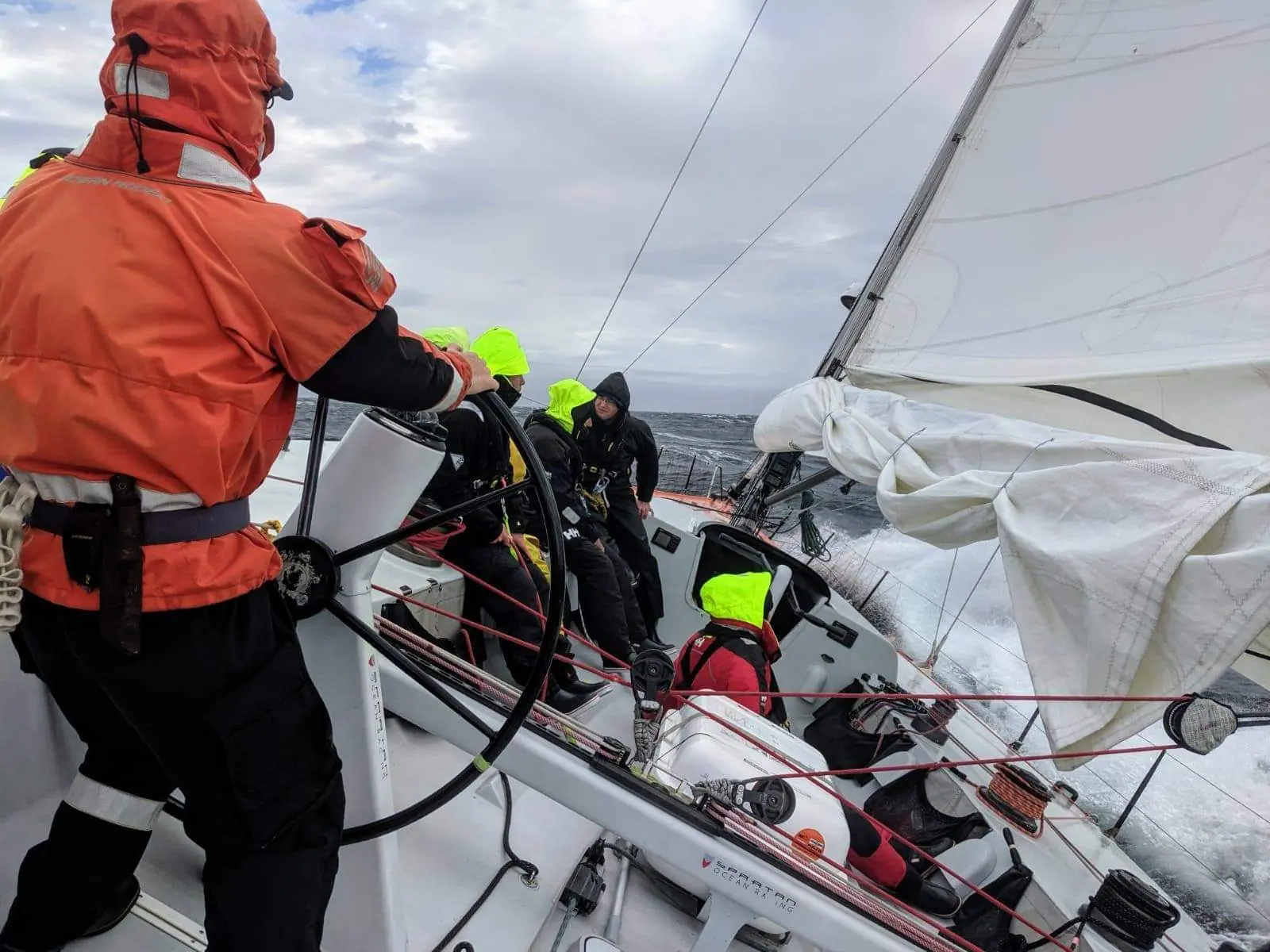
Category Zero is the highest offshore safety rating for sailing vessels. It certifies a vessel for transoceanic passages with no expectation of rescue. Category 1 covers ocean racing within 250 miles of shore. Category 2 covers races within 250 miles. Category Zero says you are going where nobody is coming to get you.
Ken has fitted three vessels for Category Zero compliance: Challenger, Osprey, and Falcon (later renamed Hellcat). This is not a checkbox exercise. It is the difference between a vessel that can survive offshore conditions and one that relies on hope and a satellite phone.
Structural Requirements
The vessel hull must be capable of withstanding capsize and knockdown without structural failure. Keel attachment points must handle the full dynamic load of a rollover. Deck fittings must remain attached and sealed through the same conditions. Companionway closures must be watertight when the vessel is inverted.
On Challenger, a Whitbred 60 with a Kevlar hull, the structural integrity was proven during the February 2016 hurricane. The vessel took 95-knot gusts, was thrown off 20-meter waves, and held together. That is what structural compliance looks like under real conditions.
Safety Equipment
Category Zero requires specific equipment, not general preparedness. Life raft rated for the number of crew with a minimum 24-hour survival pack. EPIRB (Emergency Position Indicating Radio Beacon) registered and tested. SART (Search and Rescue Transponder). Handheld VHF radios, minimum two. Pyrotechnics: flares (parachute and handheld), smoke signals. First aid kit to offshore specification.
Personal equipment for each crew member: inflatable PFD with harness, integrated light, whistle, and personal AIS beacon. Safety tether with two hooks. Jacklines running the full length of the deck, both sides.
Every single item has a specification. The PFDs must be a certain buoyancy rating. The tethers must meet a load rating. The jacklines must be attached to structural points, not deck hardware. None of this is optional and none of it is approximated.
Redundancy Requirements
Category Zero demands redundancy in critical systems. Two independent means of pumping the bilge. Two independent means of navigation. Two independent means of communication, at least one of which is long-range. Two independent means of generating electrical power.
This is where most vessels fail their first inspection. A single bilge pump is not sufficient. A single GPS unit is not sufficient. A single VHF radio is not sufficient. Every system that the vessel depends on for survival must have a backup that operates independently of the primary.
On Osprey, the redundancy includes Starlink for communications alongside traditional SSB and VHF, dual GPS systems, manual and electric bilge pumps, and multiple charging sources including solar, alternator, and generator. When one system fails, the backup is already in place.
Inspection and Documentation
Category Zero compliance requires a formal inspection by a qualified authority. The inspector checks every item on the equipment list, verifies installation, tests operation, and confirms expiry dates on all time-limited equipment. Pyrotechnics expire. EPIRB batteries expire. Life raft servicing has intervals.
The documentation is extensive. Equipment inventories, service records, crew qualification certificates, vessel safety certificates, and inspection reports. All of this must be on board, organized, and current. An expired pyrotechnic is a failed inspection regardless of everything else being perfect.
Ken maintains this documentation as part of vessel management. When inspection time comes, the paperwork is already done. The equipment is already current. The vessel is always ready, not scrambling to pass an inspection on short notice.
Why This Matters for Non-Racing Vessels
Category Zero was designed for offshore racing. But the principles apply to any vessel that goes beyond coastal waters. A cruising yacht crossing to the Bahamas faces the same ocean as a racing yacht in the same waters. The weather does not check your race entry before sending a storm.
Applying Category Zero thinking to a cruising vessel does not mean buying everything on the racing equipment list. It means applying the same systematic approach to safety. Identifying what can fail. Providing redundancy for critical systems. Maintaining equipment to known standards. Documenting everything.
The February 2016 hurricane hit Challenger in the same waters that recreational cruisers transit every year. The same storm forced a 168,000-ton cruise ship to turn back. Challenger survived because she was fitted to Category Zero standards. The equipment worked because it was maintained. The crew survived because they were prepared.
Three Vessels
Challenger, Osprey, and Falcon. Three vessels fitted by Ken for Category Zero. Each one required a full audit of existing equipment, identification of gaps, sourcing of compliant equipment, proper installation, testing, and documentation. Each one passed inspection. Each one went offshore.
This is the standard that 3D3D applies to every vessel management contract. Not every vessel needs Category Zero certification. But every vessel deserves the same systematic approach to safety, maintenance, and documentation.
This is what Managed Care looks like
Category 0 preparation requires this level of attention. Managed care brings the same standard to every vessel.
Learn about vessel management retainers →